A few months ago, someone messaged us saying they’d applied to a “100% remote” job posting, made it to the final interview round, and then got rejected — not because of their skills, but because the company only hired within specific U.S. states. They’d assumed “remote” meant remote from anywhere. It doesn’t always.
That mix-up happens more often than you’d think, and it usually comes down to one thing: people treat “remote” and “work from home” as interchangeable words. Most of the time they overlap. But not always — and the gap between them is exactly where good candidates get filtered out before they even get a real shot.
Here’s what actually separates the two, so you stop wasting applications on jobs you were never eligible for in the first place.
What Is a Remote Job, Exactly?
A remote job means you’re not tied to a physical company office. That’s the baseline definition. But “not tied to an office” is not the same as “work from wherever you want” — and this is the part job listings rarely spell out clearly.
You’ll commonly see postings worded like:
- Remote – USA only
- Remote – UK only
- Remote – Must reside in [specific states]
- Remote – Within EST/CST time zones
Technically, all of these are still “remote” jobs — there’s no office you’re expected to show up to. But the employer has quietly boxed in where you’re allowed to live while doing the work. Usually it’s about payroll and tax compliance, not preference — a US company legally hiring in California operates very differently from one hiring in Karachi, and most employers aren’t set up to handle that complexity.
The upside of remote work, when the restrictions do work in your favor, is real: no daily commute, and often more control over your physical workspace.
What Is a Work-From-Home Job?
A work-from-home (WFH) job is more specific — your home is treated as your actual, primary workplace, not just “somewhere outside the office.”
Picture a customer support agent who’s allowed to work entirely from home, but is still expected to be at that home address, on a stable connection, during their assigned shift. That’s a work-from-home arrangement. They can’t take the laptop to a coffee shop for the afternoon or work from a different city that week — the home is the job site, in a sense.
The simplest way to hold this in your head:
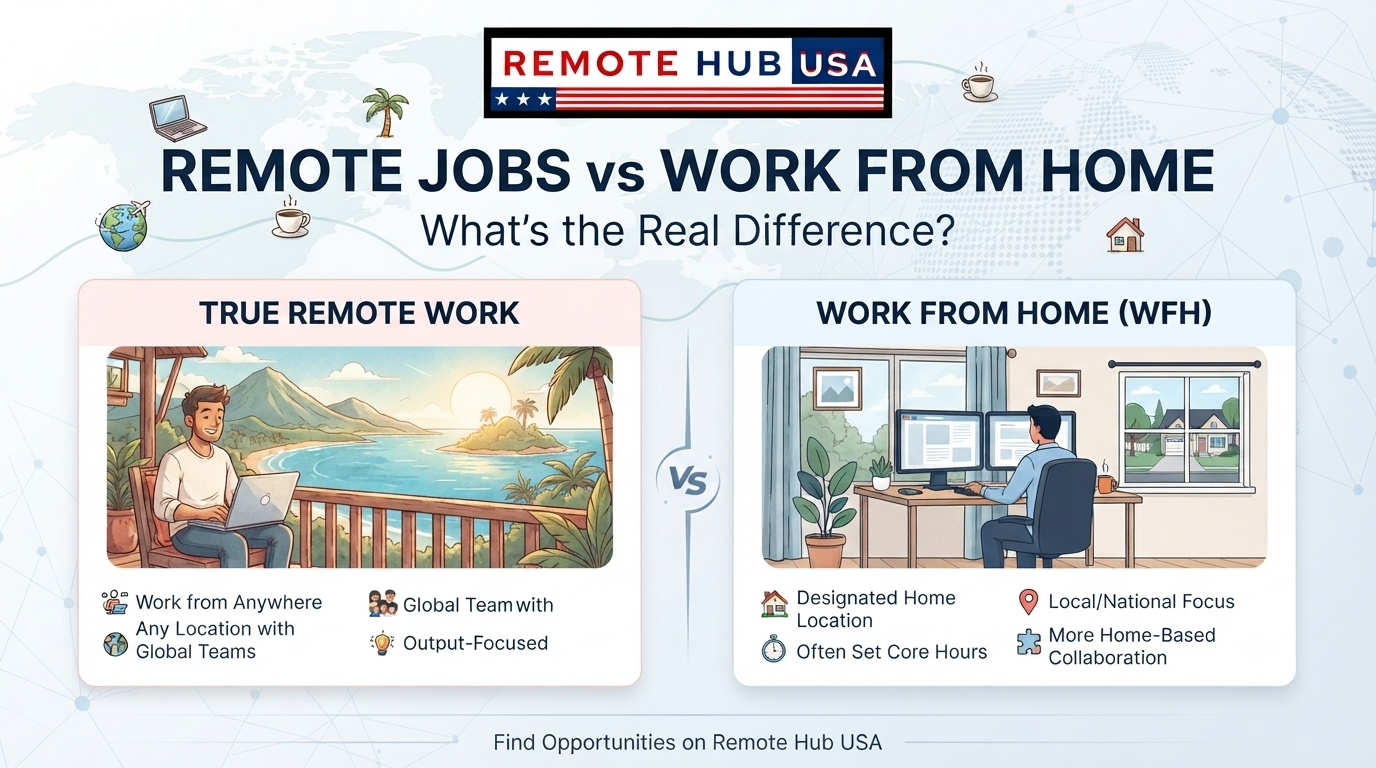
Work from home is usually a type of remote work. But remote work doesn’t always mean you’re limited to working from home.
Remote vs Work From Home — Side by Side
| Remote Job | Work-From-Home Job |
|---|---|
| Works outside a traditional office | Works primarily from home |
| May allow multiple approved locations | Home is normally the required workplace |
| Can carry country or regional restrictions | May require a specific home-location setup |
| Often offers more location flexibility | Usually means a stable, fixed routine |
| Occasional office visits depend on the employer | Office visits are less common but not impossible |
One honest caveat here: employers themselves aren’t consistent about these labels. We’ve seen “remote” postings that were functionally work-from-home jobs, and “work-from-home” postings that allowed employees to relocate freely. Read the actual job description — the label on the listing is marketing, not a contract.
Does “Remote” Mean You Can Work From Anywhere?
No — and this is the single most common assumption that trips people up.
A company can market itself as “fully remote” and still only be legally able to hire people in certain countries or states. This usually comes down to things most job seekers never think about: local employment law, tax withholding, payroll infrastructure, and data-handling regulations. A company isn’t being difficult on purpose — hiring someone in a country they have no legal entity in creates real compliance headaches for them.
So a listing might say “100% remote” while quietly requiring that you already be authorized to work in the United States. Another might allow remote work broadly but still expect you online during specific U.S. business hours, regardless of your actual time zone.
Before you apply, check three things: where you’re allowed to be located, whether you already have the right to work there, and what time-zone overlap they expect.
Where Does Hybrid Work Fit In?
Hybrid work sits between the two — part office, part home. A common pattern looks like in-office Monday through Wednesday, then remote Thursday and Friday.
Hybrid can be a solid middle ground if you want flexibility but still like having face time with a team. If your actual goal is zero commuting, though, don’t apply to hybrid roles hoping they’ll “eventually go fully remote” — look specifically for postings that say fully remote from the start.
So Which One Should You Actually Look For?
Neither is objectively better — it depends on what your week actually needs to look like.
If you value flexibility in where you physically work — different room, different city occasionally, maybe a co-working space — lean toward remote roles that don’t over-restrict location. If you’d rather have one consistent setup and don’t want travel or office politics in the mix at all, a home-based role fits better.
Before choosing, it’s worth being honest with yourself about a few things:
- Where are you actually allowed to work from, legally?
- What hours can you realistically commit to?
- Is your internet and equipment reliable enough for the role?
- Are occasional office visits or travel required?
- Does the employer have hard location restrictions you’d need to meet?
The right job is the one that fits how you actually live and work — not the one with the catchiest title in the listing.
Jobs You’ll Commonly Find in Both Categories
Web and Software Development
Developers often work fully async using code repositories, project boards, and messaging tools — one of the easiest fields to do 100% location-independent, when the employer allows it.
Digital Marketing and SEO
SEO, social media management, email marketing, and paid ads roles are commonly hired remote, since most of the work happens inside software dashboards anyway.
Graphic Design
Designers collaborate with clients and teams through shared design tools and async feedback — client-facing, but rarely requires physical presence.
Customer Support
Frequently structured as work-from-home specifically, since shift coverage and a stable connection matter more than location flexibility.
Content Writing
Writers producing articles, product copy, or marketing content typically work fully independently, on their own schedule within deadlines.
Virtual Assistance
VAs handle scheduling, inbox management, research, and admin work for clients — one of the more flexible entry points into remote work.
Before You Apply: A Quick 5-Point Check
Don’t apply just because a posting says “Remote” or “Work From Home” in the title. Spend two minutes checking:
- Location — Is someone in your country actually eligible?
- Working hours — Flexible, or tied to a specific time zone?
- Employment type — Full-time, part-time, contract, or freelance?
- Office requirements — Any occasional travel, training, or in-person meetings?
- Equipment — Does the employer provide a laptop, or is that on you?
This alone will save you from applying to roles you were never going to be eligible for — which, if you’ve job-hunted for any length of time, you know eats up more energy than it should.
How to Spot a Remote Job That Isn’t What It Claims to Be
Be cautious when a listing:
- Promises unusually high pay for very little described work
- Skips a normal interview or hiring process entirely
- Asks you to pay anything before you start — training fees, “starter kits,” software access
- Doesn’t clearly name the actual company
- Pressures you into deciding fast, with no time to research them
Take a few minutes to look the company up before sharing anything personal or financial. A legitimate employer will still be there tomorrow — the ones rushing you usually won’t be.
Final Thoughts
The difference, boiled down: remote means working outside a traditional office, while work-from-home specifically means your house is the workplace. But because employers use these words loosely, the label on a listing tells you less than the actual job description does.
A “remote” role can still come with strict location or time-zone rules. A “work-from-home” role can still expect you glued to one address during set hours. Neither is a red flag by itself — it’s just information you need before you invest time applying.
The best remote opportunity isn’t the one with the most flexible-sounding title. It’s the one that actually fits where you live, how you work, and what you’re qualified to do.
Frequently Asked Questions
What is the main difference between remote jobs and work-from-home jobs?
A remote job allows you to work outside a traditional office and may permit multiple approved locations. A work-from-home job usually means your home specifically is the required workplace.
Is a work-from-home job considered a remote job?
Generally yes — working from home is a form of remote work since you’re outside the company’s office. The difference is that the employer may require you to work specifically from that home location.
Does a remote job mean I can work from anywhere?
No. Many remote jobs are restricted to specific countries, states, or time zones for legal and payroll reasons. Always confirm location requirements before applying.
Can I work from another country in a remote role?
Only if the employer explicitly allows it. Some companies support international remote hiring; many only hire within countries where they’re legally set up to do so.
What’s the difference between remote and hybrid work?
Remote work happens entirely outside the office. Hybrid work combines remote days with scheduled in-office time.
Do remote jobs have fixed working hours?
Sometimes. Some remote roles offer flexible hours, but many still require overlap with specific business hours or time zones.
What equipment do I typically need for a work-from-home job?
A reliable computer, stable internet, webcam, headset, and a quiet workspace are common baseline requirements. Some employers provide equipment; many don’t.
How can I avoid fake remote job listings?
Be skeptical of postings promising unrealistic pay, skipping a real hiring process, or asking for payment upfront. Research the company independently before sharing personal information.
Which is better — remote or work-from-home?
Neither is universally better. It comes down to whether you want location flexibility (remote) or a fixed, stable home-based routine (work-from-home).
Helpful Tools For You.
- USA Salary Calculator – Estimate your real take-home pay.
- Freelance Rate Calculator – Calculate your ideal freelance hourly rate.
- TimeSync Pro – Convert time zones for remote team scheduling.