
Some mornings you open your laptop and feel nothing. No energy, no urgency, and the afternoon looks very long. If that’s you, you’re not broken. It’s one of the most common things about working alone.
The advice I’d push back on is “find your motivation.” Motivation isn’t something you find. It tends to show up after you’ve started, not before. So the useful question isn’t “how do I feel motivated?” It’s “how do I start anyway?”
Make the first step ridiculously small
“Write the report” is a mountain. “Open the document and write one ugly sentence” is a step. Once you’re in, momentum often takes over.
A trick that works for a lot of people is the five-minute deal: you promise yourself five minutes on the task, and you’re allowed to stop after that. You usually won’t want to.
Fix your surroundings before you blame yourself
If your phone is in your hand, your TV is on, and your bed is three feet away, it’s not a character flaw that you’re distracted. It’s a setup problem.
Change the setup. Phone in another room. A fixed work spot. Clothes that aren’t what you slept in. None of this is glamorous, but all of it removes decisions, and fewer decisions mean less willpower spent.
My Personal Experience:
One day, when I had zero motivation to work and kept endlessly procrastinating, I dropped everything and tried one simple thing: I plugged my phone in to charge in another room and wrote down just one tiny task on a notepad. The moment that digital distraction was out of sight, the mental resistance vanished. I got straight to work and stayed completely locked in for the next two hours without looking up.
Keep a visible scoreboard
At the end of each day, write one thing you finished. Just one. On days where you feel like you got nothing done, that list is proof you did. Over a month it becomes a record you can actually look back on, and that is more motivating than any quote on a wall.
Don’t let it get lonely
This one gets underestimated. A lot of “low motivation” at home is really low contact. No one to joke with, no small wins shared.
You don’t need much. A message to a coworker, a call with a friend at lunch, or working from a library once a week can change your mood more than any productivity trick.
Move for ten minutes
A short walk won’t change your life, but it changes the next hour. If your afternoons feel foggy, this is usually the cheapest fix.
Remember why you wanted this
Money, freedom, being around family, learning a new skill, whatever it is, write it down in one line and put it where you can see it. On bad days, it reminds you that this is a choice you made for a reason.
When it’s more than a slump
A slow week is normal. But if you’ve felt flat, hopeless, or exhausted most days for a few weeks, and sleep, food, and workload don’t explain it, please talk to a doctor or a mental health professional. That’s not a productivity problem, and getting help is a sensible step, not a failure.
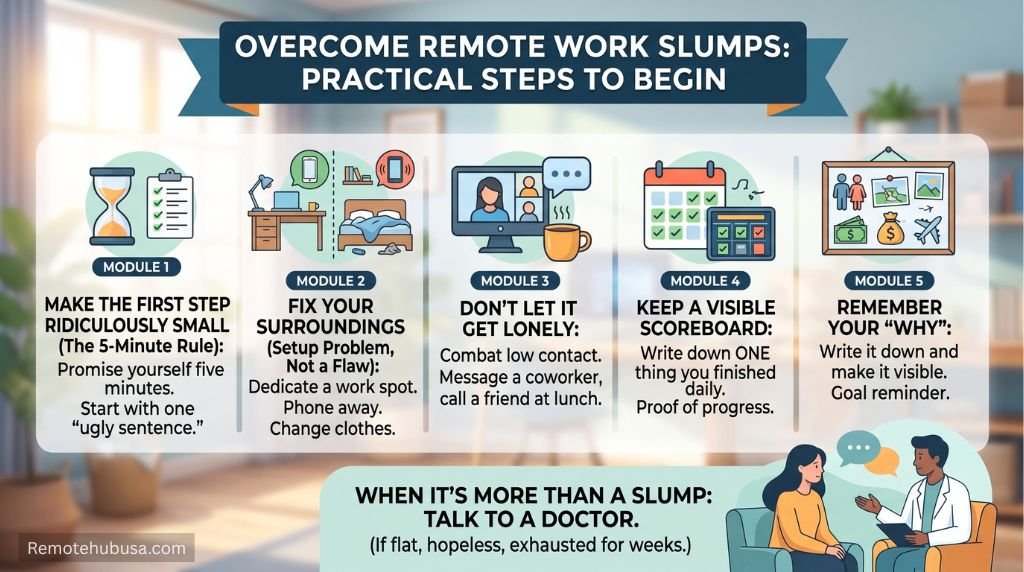
Final Thoughts: How to Actually Start
The most honest lesson here is that motivation isn’t magic—it doesn’t just fall from the sky. We often wait to “feel in the mood” before starting, but the truth is: motivation comes after you start, not before. If you open your laptop and feel completely blank, you are not broken. It is simply the most common part of working alone.
To fix this, here are a few simple, everyday steps:
Make the mountain a pebble (The 5-Minute Rule): Instead of panicking over a huge project, promise yourself, “I will only work on this for 5 minutes and then I can stop.” Once you take that first tiny step, your brain naturally gets into the flow and you rarely want to stop.
Blame your setup, not yourself: If you are working in bed with your phone right next to you, getting distracted isn’t a lack of willpower—it is a bad environment. Just like my personal experience: The day I put my phone to charge in another room, my mental block instantly disappeared, and I worked with deep focus for two straight hours.
Low motivation is often just loneliness: Working alone at home can be isolating. Sending a quick message to a coworker or calling a friend on your break can boost your mood much faster than any complicated productivity hack.
Keep a visible scoreboard: At the end of the day, write down just one thing you completed. On days when you feel like you did nothing, this simple list will remind you of your actual progress over the month.
Remember your “Why”: Why did you choose remote work? For financial freedom? Family time? Write your reason down and keep it visible. On bad days, it reminds you that you chose this path for a purpose.
Two quick questions
Is it normal to feel lonely when you work from home? Yes, very. Plan contact on purpose rather than hoping it happens.
Should I really get dressed for it? You don’t need to dress up. But many people find that changing clothes marks the start of work. Try it for a week and see if you notice a difference.
Tomorrow morning, skip the big plan. Pick one small task, set a timer for five minutes, and begin. If you’re still searching for work, our list of legit remote jobs with no experience is a good place to start.